I think the kinds of people who engage in gang violence or monetary crimes over drugs fit into the category of "bad, antisocial" people I mentioned. Society would have to deal with their proclivities whether or not their energies were directed towards illegal drugs or something else.
That's quite an amazingly strong claim of biological essentialism. Got any data to back it up?
It would be naive to imagine that there is no "fundamental nature" element to people. That your genes or early childhood experiences or whatever do not make some people more prone to antisocial behavior, and indeed do not make some people guaranteed to be extremely antisocial. Some people who are now criminals connected with the drug trade would, in a counter-factual world of legalized drugs, find other outlets for their antisocial tendencies.
But it's just as naive, perhaps more so, to imagine that the circumstances that people find themselves in do not also affect their social/antisocial behavior. A hundred and sixty years ago, millions of people in the United States actively participated in a monstrous crime perpetrated against an entire race of people, the equivalent of what in the modern world would be multiple felonies per day across their lifetimes. It was certainly antisocial. Was that destiny? Were all those people just inherently bad? If so, what happened to them? Why doesn't modern Georgia have most whites being serial felons?
There is something very important missing in your "nature vs. nurture" worldview, which is: people can and do think for themselves and thereby determine their own values.
For instance, you attribute the grandparent's point of view to "biological essentialism." The grandparent said no such thing. He said: certain people are prone to crime. That is true. Those people are acting out their values and their ideas about the world and about how they can best survive and cope within it. I don't agree that everyone who is a drug criminal would necessarily find some other avenue of crime, but to suggest that they would is not a claim to biological essentialism.
> A hundred and sixty years ago, millions of people in the United States actively participated in a monstrous crime perpetrated against an entire race of people, the equivalent of what in the modern world would be multiple felonies per day across their lifetimes. It was certainly antisocial. Was that destiny? Were all those people just inherently bad? If so, what happened to them? Why doesn't modern Georgia have most whites being serial felons?
What happened is the spread of ideas about human rights from the Enlightenment. Slavery has been the norm for 99% of human history. The Southerners you talked about just didn't have the great newfangled idea of people having rights. That was a real intellectual achievement that took humans thousands of years.
I'm not suggesting anything is biological. But the guy who has never had a real job other than crime isn't not a "bad, antisocial person" just because you can ascribe his condition to his circumstances growing up. Nor can you say that the drug war created those circumstances.[1] The drug war didn't create these insular low-income communities that don't trust the police. It didn't create households where fathers abandon their kids. It didn't create the vacuum of social authority in these communities that is filled by the gangs.
Say you end the drug war, legalize everything so you can go into Wal-Mart for a hit of heroin. What happens? The gang members driving around shooting each other aren't going to go get jobs (there aren't any). Heck, you might dry up a lot of what little income flows into these communities.
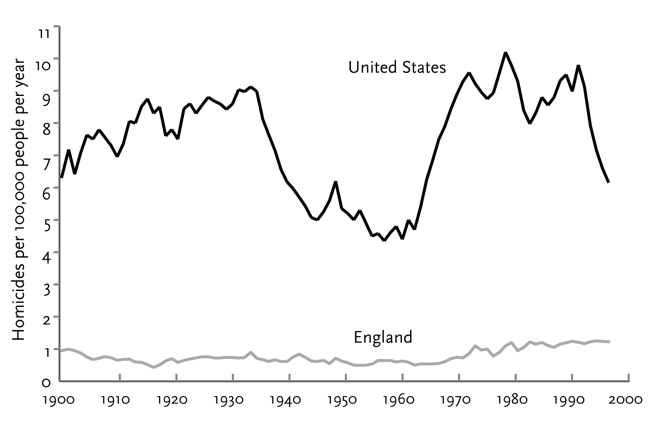
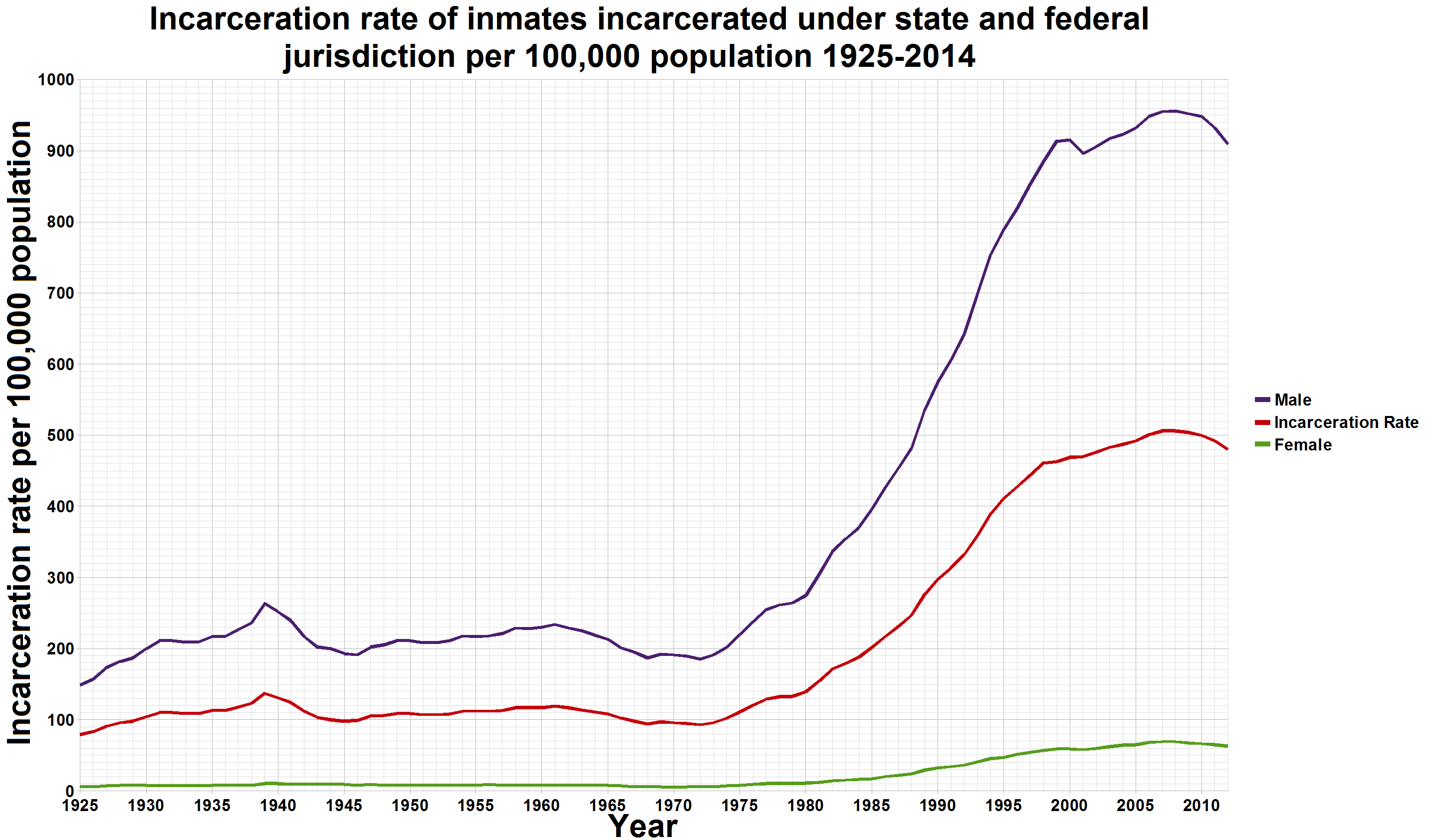
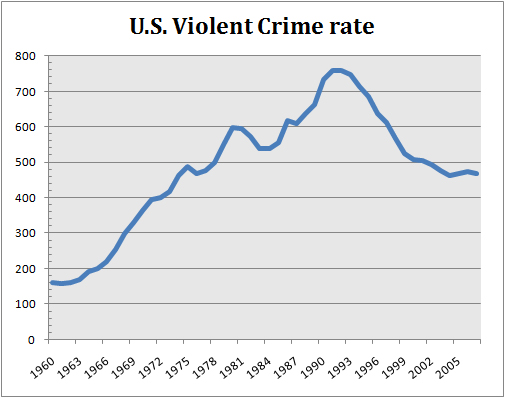
The first image is the number of homicides per capita. After hitting a minimum in the late 1950's, it starts increasing again in 1960. By the early 1970's, it's at historical highs (last seen in the 1930's). The second image is incarceration rate, which we can use as a proxy for the intensity of the drug war. Note how it's almost flat till about 1973-1974, and starts really increasing around 1975-1980. The third image is a comparison of America's murder rate to that of the U.K. Note how we have always been a dramatically more violent society throughout the entire 20th century.
The final thing to note is that the peak murder rates of the 1980's are similar to those of the 1930's. In other words, homicides went down dramatically in the 1940's and 1950's, but returned to their previous levels by the 1960's and 1970's. Don't be quick to ascribe the first peak to Prohibition, either. Prohibition lasted from 1920-1933. You can see it caused an increase in homicide rates, but the rate from 1900-1920 was already very high, and Prohibition didn't increase it that much relative to how much it went up from 1960 to 1980.
So what causes this pattern? Is it Prohibition or the Drug War? Or are those just relatively small effects on top of much larger phenomena? The social upheaval of the 1900's-1930's and of the 1960's to 1980's?
You seem to be really caught up in this idea of hard-core gang members. And, sure, it's true: people who have committed fully to lives of violent crime are deeply unlikely to turn around and become model citizens.
But: if they don't have an income to support their lives of crime, and if their leaders don't in fact have quite a nice income that the more common criminals can aspire to, there's going to be much less incentive for people who are deciding what they want to be to choose a life of crime.
And furthermore: committed, full time violent criminals are not the only people we care about here. People whose lives are impacted by the black market nature of the drug trade include many criminals who may in fact have a job, and do some crime on the side. It also includes people who are drug consumers, not dealers, who would materially benefit from a safer and hopefully cheaper drug habit.
And it also includes people whose boyfriends and fathers would not be in jail now, and if a large number of those boyfriends and fathers would not be material help to their girlfriends and children, some number of them would be.
Is this it? Is it the only policy that we would need to vanquish poverty and crime in the US? Of course not. But there's a reasonable argument that you can't meaningfully address poverty and crime without addressing the drug war -- that it blocks any other attempt to improve conditions in poor, crime-stricken communities.
> You seem to be really caught up in this idea of hard-core gang members.
I'm not. The vast majority of the gang members driving around shooting each other up are not "committed fully to lives of violent crime." But they are still "bad, antisocial" people. The 19 year old who mugs someone in a gang initiation ritual is still a bad person even if you can explain his behavior in socioeconomic terms.
> Is it the only policy that we would need to vanquish poverty and crime in the US? Of course not.
Obviously the drug war contributes to poverty and crime in the U.S., I'm not denying that. But the comment I originally replied to stated: "Interesting to see an effect of the drug war manifested on a map." As if that state penitentiary wouldn't need to exist without the drug war.
People dramatically overstate how much the drug war contributes to violence in the U.S., because their world views (usually individualist ones), don't grapple well with a world where a meaningful percentage of the population is bad and antisocial. If only the government didn't prosecute this drug war, they say, we wouldn't need these prisons! People would get along! But the data just doesn't support that narrative. Look at this chart of spending on drug control: http://cdn6.theweedblog.com/wp-content/uploads//us-drug-addi..., and cross reference that against the homicide rate chart I referred to earlier. You can clearly see that most of the dramatic increase in homicides between the minimum in the late 1950's and the maximum in the 1980's and 1990's happened by the early 1970's, while drug war spending didn't really start until 1973 and didn't really ramp up by the 1980's.
We're not seeing the product of communities ravaged by the drug war. What we're seeing is that the drug war has become the focal point for communities that were already disintegrating before the drug war even started.
Yes, but how did they get that way? They got that way because they were drawn into that life by older gang members. They see older gang members living a life of relative privilege and they're willing to accept the violence that goes along with it. If you take away the money, those older gang members become much less attractive role models.
> As if that state penitentiary wouldn't need to exist without the drug war.
From Wikipedia: "In the twenty-five years since the passage of the Anti-Drug Abuse Act, the United States penal population rose from around 300,000 to more than two million."
In that same time period, when the prison population increased over 600%, the US population increased roughly 30%. Unless you've got some other theory for drastically increased incarceration rates, that prison and many others used to house the over 1.5m extra prisoners we have today because of the WoD literally would not exist.
I spent several comments laying out a theory for the increased incarceration rates, supported with charts and graphs.
The bottom line is that the increase in incarceration rates is the result of a dramatic spike in crime rates starting in 1960, peaking in the early 1990's, and the public response in the form of harsh sentencing laws in the 1990's (three strikes, mandatory minimums). It's a simple explanation: there are more people in prison because there is more crime, and because the spike in crime caused people to vote (by overwhelming margins, I might add) for harsher sentencing laws.
The popular counterargument is that the increase in crime is itself a result of the social effects of the Drug War, e.g. the impact on kids of fathers being sent to prison for decades on drug charges. But the Anti-Drug Abuse Act was passed in 1986, and the spike in violent crime rates started in 1960. The slope of the crime increase between 1966 and 1972 is as high as at any time after the drug war really got going in the 1980's, and 80% of the total increase in crime between the 1960 trough and the 1993 peak happened by 1980. It is simply inconsistent with the data to say that the increase in crime since 1960 were anything more than moderately impacted by the Drug War, which didn't really get going until long after crime had already skyrocketed.
I tend to agree. Except that going through withdrawal is one of the most painful, tortuous experiences modern humans are likely to find themselves in. It's truly dreadful. Just knowing that torture is waiting for you around the corner can make you extremely anxious. Knowing that relief can't be found easily because of arbitrary rules makes it even worse.
Faced with such torture, people might do things they might not otherwise do.
The other article that was posted here today about the US prison problem noted that crime went down significantly after prices of crack cocaine dropped, which would be a counterpoint to the conclusion you've drawn.
The per capita homicide rate in the U.S. more than doubled from 1950 to 1973, in a consistent trend. The peak happened in 1980, but most of the increase happened in the late 1960's. Nixon didn't even coin the term "war on drugs" until 1971, and the real crackdown and jump in incarceration didn't happen until Reagan in the 1980's.
The drug war isn't helping, of course, but its unlikely to be the root cause given the timing of things. More likely the root cause is the ghettoization of the cities due to white flight and wealth flight in the 1950's and 1960's, along with the continued effects of trade liberalization taking away low-skill jobs.